
We all have an internal compass. Things that we believe with our whole heart. These beliefs are part of us, internalized, and guide every action we make. They are your values. They define you. Here are the five guiding principles that govern how I operate and who I am.
1. It takes a village. But those villagers better be working together.
So we’ve all heard the saying that ‘it takes a village to raise a child.’ Many people and influences converge to support a child in becoming a happy, healthy, contributing citizen of planet Earth. Many factors are at play: parents and other caregivers, teachers, coaches, school systems, friends, community, health, environment, history…as well as the resources that all these parties have available to them and the adults’ and child’s effectiveness in navigating and applying these resources. I call this a child’s context. Where an individual child is situated with all these factors generally influences that child’s success trajectory. If any part of this is misaligned or deficient in some way, the child’s success suffers. This is why children with multiple risk factors generally struggle more. They have more barriers to overcome.
This is why alignment is so important.
I might go so far as to make it Guiding Principle 1a.
All the people and systems that touch a child need to be working together – or at least operating under the same principles – to support that child toward a common goal. And if there are barriers or negative influences, the other parts will need to work harder to counteract the negative ones.
Imagine a stream. For much of stream’s path, it flows unobstructed. The sunlight sparkles on the surface as it bubbles and flows smoothly along. Birds and deer come to the edge to drink. Smaller streams feed into the big stream, adding to its volume and abundance. People flock to the stream to enjoy the natural beauty. They feel sense of calm. The stream gets where it needs to go easily and without a lot of effort. Everything is flowing together in the same direction.
Then, imagine a second stream. This stream flows through a treacherous ravine. Dead trees line the edges and some have fallen into the water creating obstructions. Large boulders have fallen from a high cliff to create a dam. The water from the stream pushes against these obstructions and slows. In other places, the pressure creates rapids and the water churns and thrashes violently. Animals avoid the steam’s rapids because it’s too dangerous. Few smaller streams contribute to the larger stream. When it’s dry, the stream shrinks in volume and in some places nearly dries up. People generally don’t visit because it’s hard to get to, a little dangerous, and a bit scary. There are signs warning visitors of the dangers and discouraging them from getting too close.
Now, imagine these are 2 different children.
The first child has a lot of resources, few barriers, and a lot of people who are there for a common purpose and value the stream for what it is.
The second child needs to overcome a variety of barriers to get to their destination. They struggle against these barriers and it slows their progress. There aren’t a lot of contributing resources and not a lot of people. Sometimes the child is alone and feels invisible, as if they were the stream drying up for lack of rain.
But then, imagine that you and your team remove some of the dead trees and pull out some of the boulders. The water flows more freely. Maybe you build a bridge to allow people to get to and across the stream safely. And maybe you add facilities, resources, and signage that explains how the stream contributes to the ecosystem. The perceived value of the stream increases, even though the value has been there all along.
So this metaphor shows us how all these factors might work together to create a positive outcome for a child. One thing…on program…one strategy is probably not going to have some miraculous effect. Each element might contribute a little, but you’ll need a whole package of interventions and support that are aligned with each other. And all the adults – parents and caregivers, educators, community – must also be on the same page. This is why it is often so hard to move the achievement needle. You’re only focusing on one thing.

2. Handholding is not dead.
People don’t read. Especially directions.
I get it. We’re all busy. Reading, interpreting, and comprehending, and then putting that comprehension into action takes a lot of time and effort. Sometimes you’re in a ‘just the facts, ma’am’ position. You just need to know what you need to do so you can check off that task. And of course we all learn differently. Sometimes we forget that, like children, adults learn best in different ways and at different speeds too. Some like to read written directions. Some prefer to listen. Ask questions. Practice. It is different for everyone and even different depending on what’s going on around you.
Sometimes all of us need to be taken by the hand and led through a process. Walked through it step by step.
Because everyone’s overwhelmed.
Particularly as a result of the COVID-19 pandemic, educators are being pulled in multiple directions and asked to take on more and more just to keep the day-to-day running. They don’t have any extra time to read, interpret, consider, and then act. And then sometimes you’ve read something 10 times and still aren’t sure what to do.
In my 20 years working with educators, two things have been instrumental in my success and the success of those I serve: patience and hand holding.
Part of this is that I recognize that spending time and effort up front to make sure everyone knows what they need to know and how to do it will yield a better result and prevent having to correct mistakes, but it’s also a matter of compassion. Everyone is fighting an internal battle that they don’t share. We all have multiple competing priorities. But if people feel more confident and truly understand what they need to do, they feel less overwhelmed and can be more effective. That’s good for them and those around them (especially the tiny humans).
So, virtually holding hands and walking through processes step by step and explaining the ‘why’ behind those steps will always be part of my approach. It’s good for you, it’s good for me, and it’s good for the children we collectively serve.
3. It’s all about the people.
Programs don’t improve outcomes, people do.
According to this article from Harvard University’s Center on the Developing Child, “The single most common factor for children who develop resilience is at least one stable and committed relationship with a supportive parent, caregiver, or other adult.”
In other words, children who develop resilience – and resilience is an important factor in success – have at least one positive relationship with an adult, and the child knows that adult cares about them.
We’re not talking about exchanging pleasantries here. We’re talking about a real connection. One where the child feels connected on a deeper level with an adult and the adult reciprocates. Strong, positive, healthy relationships between children and adults are the basis of changed and successful lives.
This is the stuff of movies here, folks. Teachers or mentors inspiring and connecting with students can result in some life-changing transformation. (Here’s a list of 12 of movies. And I’d probably add Finding Forrester, Sister Act 2, and Good Will Hunting. :) ) While we’re not in a movie, these kinds of transformations are possible.
Many youth who decide to pursue teaching as a profession do so because they were inspired by one of their own teachers.
The challenge that many schools and programs face is that their staff may not be fully invested in the students all the time. This sounds harsh, but hear me out.
If we’re being honest, many educators are burned out, or at best, stressed out. Or they’re struggling with personal challenges. Or just really busy. All of the above. Sometimes we all just go through the motions. Just trying to get through the day. Perhaps they’ve stopped believing that EVERY child has potential. Perhaps they’re jaded. Maybe they’re doubting themselves or have a case of imposter syndrome. It’s really hard to BE a successful educator when you don’t FEEL like a successful educator. If a teacher is stressed, that stress will come through in their teaching. It will be harder for them to foster effective relationships with students.
We need to take care of our educators so they can take care of and effectively lead their students, no matter how well instruction is designed, aligned, and implemented.
4. You have to DO something.
Years ago, when I was first getting started as a program evaluator I took a professional learning workshop about program theory. Essentially, how do programs get results? At the time, I was more focused on the front end of programs, supporting educators in securing grant funding. The workshop instructor – I’m pretty sure it was program evaluation legend Dr. Mark Lipsey – shared a cartoon that illustrated how most people approach programs and triggered a light bulb moment for me (check out the original cartoon here).
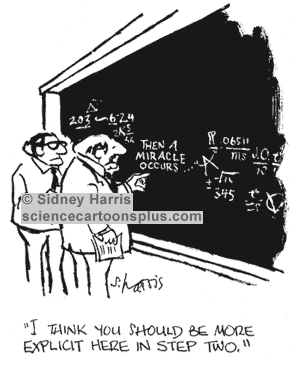
In my role at the time, here is how it was playing out. This is what I call Miracle Program Theory.
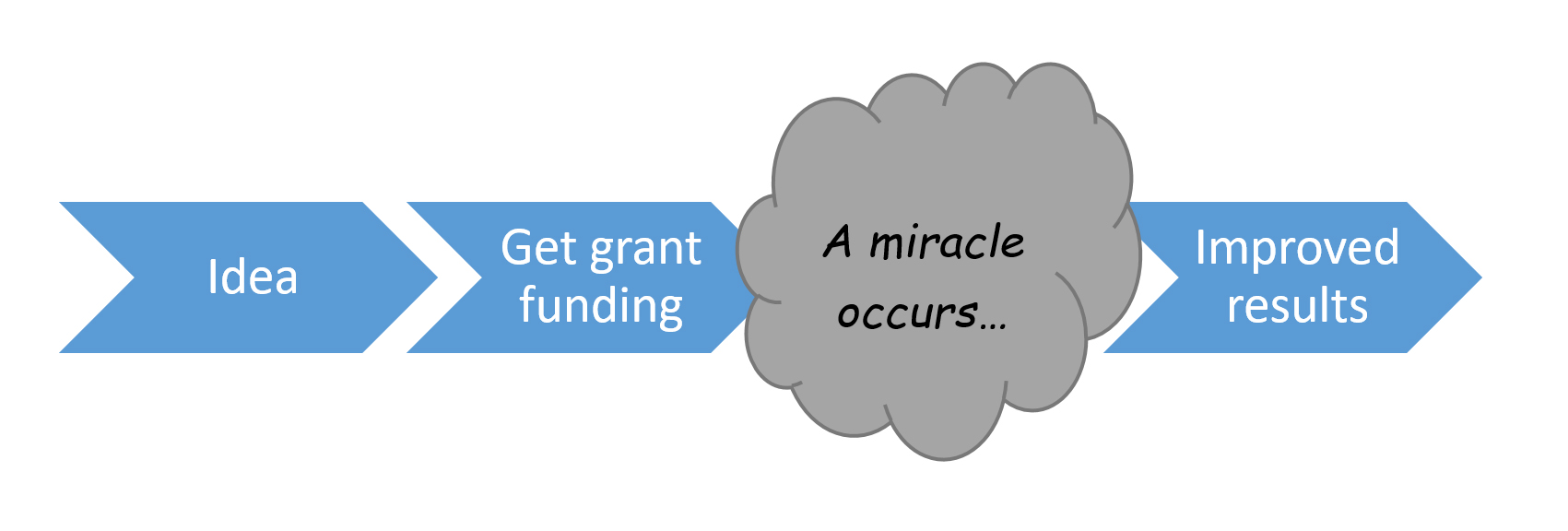
Maybe you can relate. Your agency’s leadership or school board has said to you, “yeah, that’s a great idea. But that’s not in the budget. You should go get a grant for that.” As if the grant was the thing that would trigger the improvement. They had a “If we just had the money” mantra.
Here’s a tip. A grant will not solve your problem. Throwing money at the problem is not a solution. It’s all about what you DO and how you do it. You have to do something. And the thing you do needs to be aligned with what the needs are (see guiding principles #1 and 1a).
Here’s how programs actually succeed.

First, you have to identify the needs of the population to be served. This is not just a matter of gut instinct, you have to validate the need by collecting evidence.
I once worked with a program that had brought together a group of stakeholders for a formal needs assessment process. Part of that process had these stakeholders share what they thought were the most significant needs of the population. Long story short, the stakeholders were all in agreement that math was the most compelling need for the students, no question. At that time, after collecting evidence from a variety of sources, we found that math was NOT the problem, reading was. In fact, students were achieving in math nearly on par with their peers. But their reading scores – and their ability to correctly address math word problems – indicated a need for growth. Had the group proceeded with their gut instinct that math in general was the problem, they would have designed and implemented a math program. And that math program might not show a whole lot of growth. So, they’d come to the conclusion that the program didn’t work. But, the problem was not that the program didn’t work, the problem was that it was addressing the wrong thing. And the achievement gap remains unchanged.
This is why you need to validate your needs with evidence. I like to call this the myth-busters process. The good news is that this evidence can then serve as your baseline for measuring future growth.
Once you collect your needs evidence, you design a program that is likely to influence those needs. And you find and apply appropriate resources to support that program. And take aligned action with the needs and the program design, implemented by staff who are all of the same aligned positive mindset (see Law #3). Then, you have to allow some time for change to show up. (Sometimes that change might take years to show up.) And THEN, you might start to see results.
This is a much more involved process than simply do a program and change lives, which is typically how people approach this.
Which brings us to the last of my guiding principles…

5. Marginal gains are like compounding interest.
If you think you are going to change the world overnight, think again. If there is one thing that I’ve learned in my 20 years of working in education and also in looking at my own life, it’s that change – the good kind, anyway – happens slowly. People do not change overnight. Children do not magically jump two performance levels after 6 weeks of summer programming.
It takes time and the change is slow.
Change is incremental and it compounds, like interest in the bank. (Here’s a great explanation of the concept of aggregation of marginal gains.) What you want to do is accelerate a student’s learning so that over time, the student learn more, faster and more efficiently. This, of course, is easier said than done. But, if you can improve by 10% over your baseline in year 1 and then 10% over year 1 in year 2, and then 10% over year 2 in year 3, you’ll have cumulatively improved 33% over the baseline. So you picked up an extra 3% over those three years by making small improvements every year and then improving on them. Here’s an example of this using money, which might be a bit easier to understand.
Just for round numbers, let’s say you have $1,000 invested and your investment account typically yields a 10% annual return.
At the end of year 1, your $1,000 initial investment would yield $100. [($1,000 x 10% growth) + the original $1,000 investment] = $1,100.
If you left that $1,100 invested for another year, you’d have [($1,100 x 10% growth) + $1,100] = $1,210.
Year 3… [($1,210 x 10% growth) + $1,210] = $1,331.
You’re building incremental growth on growth. This is acceleration of learning and this is what leads to sustainable change over time.
Small changes over time lead to bigger results. You just have to keep at it.
I hope that my personal guiding principles help you to understand me a little bit more and also give you some ideas about how you can positively influence change for those you serve. If you want to know more about me, check out my About page. I’d love to hear what your guiding principles are! Share in the chat below.
Recent Comments